By its 250th anniversary, the United States of America has risen into a powerful symbol of freedom and progress; a nation whose extraordinary achievements command both pride and respect. Although relatively young in the broader context of world history, the foundational principles of liberty that define America have demonstrated enduring resilience. Although challenges persist, America continues to function as a society grounded in the preservation of individual liberties. However, these principles are being threatened by those with the power to strip them from the nation’s collective memory; and when these principles weaken, so too does the cohesion of the republic itself.
The Constitution and its guiding principles have endured not by chance, but through generations of freedom-loving individuals committed to the study, preservation, and reinforcement of the ideals that have historically unified America since its founding. But as shifting influences reshape education and societal values, it raises a deeper question: does a shared belief in liberty still bind Americans together, or is that foundation beginning to erode?
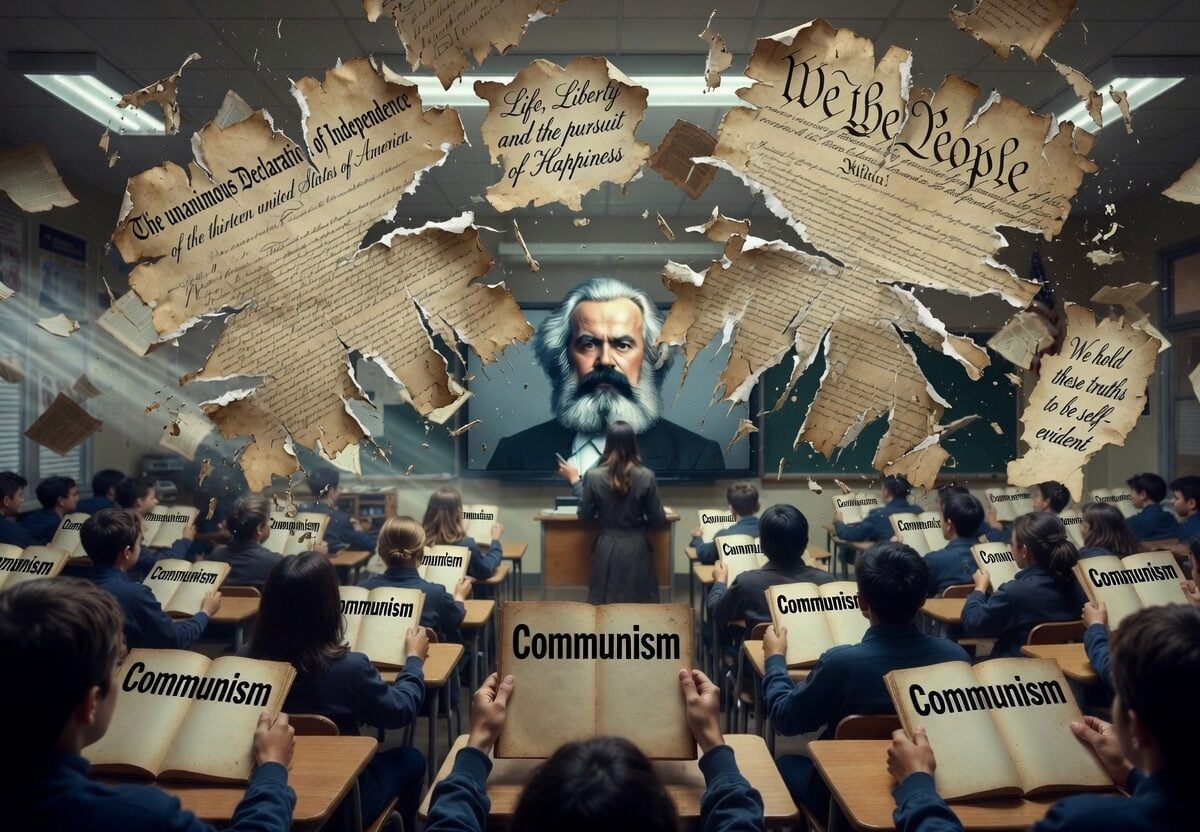
Today, the United States faces a test that differs from those of the past. Rather than a single defining conflict, it is a slow and steady ideological shift—marked by the growing appeal of socialism and a rising strain of anti-American sentiment. This shift has not emerged overnight. It is the result of decades of intellectual drift, particularly within the K-12 education system, where a lack of freedom-loving individuals in the field has left many vulnerable to persuasive but historically flawed ideas.
Thomas Jefferson cautioned against such ignorance, writing, “If a nation expects to be ignorant — and free — in a state of civilization, it expects what never was and never will be.” Jefferson’s words speak directly to the present moment. A free society cannot endure without an informed citizenry—one that understands not only its foundational ideals, but the realities that sustain them. This quotation from Jefferson issues a pointed warning against ignorance, urging citizens to cultivate not just an informed understanding of the structures and functions of government and society within a free state, but to have knowledge of the nation’s actual conditions.
Today, the ideas that support socialism are circulating across the country by those and to those who remain ignorant of its danger. Time and again, systems rooted in these ideas have produced economic failure, political repression, and human suffering. Infatuated with the promise of a “utopian” society, socialists often follow a well-worn path scarred by the failures and devastation of past communist regimes—rationalizing each misstep while remaining tethered to the vision sold by passionate leaders of the movement. The strength of the socialist movement lies largely in its power to persuade the uninformed. Even as its record of failure and destruction echoes loudly, its adherents press forward, undeterred, into a bleak future.
Many attribute the rise of this movement to the influence of social media. While social media undoubtedly shapes cultural and societal expectations, it is not the primary force driving the acceptance of socialism. Rather, its roots run deeper—more powerful, more deliberate, and far more calculated.
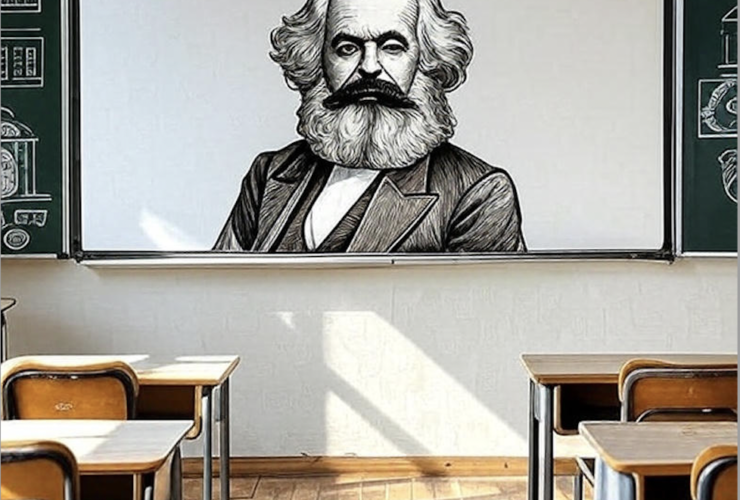
Teachers—so often underestimated in their influence—have been and remain the most effective drivers of the socialist movement. As education has drifted toward activism, classrooms have increasingly been filled by educators —or activists— intent on dismantling traditional American ideals rather than teaching them. Inspired by figures like Howard Zinn, whose work cast American history through a deeply cynical and falsified lens, they have made it their mission to replace a sense of national identity with distrust and disillusionment, leaving younger generations more detached than ever from the country they inherit. Because teachers are largely ignored in broader discussions on this topic, many Americans risk continuing down a path toward socialism without any idea that they could question where it leads.
James Madison underscored the essential link between education and self-governance when he wrote, “Knowledge will forever govern ignorance; and a people who mean to be their own governors must arm themselves with the power which knowledge gives.”
In an age of quick, constant opinions posing as facts, what one believes to be knowledge can be nothing more than a biased opinion.
People filter new information through preexisting frameworks, accepting or rejecting it based on what they already believe, or know. These frameworks are established early in life. This is where educators hold lasting influence. By shaping how individuals think—rather than simply what they know—educators help construct the mental frameworks that guide how future information is processed and understood. Teachers often design lessons in ways that lead students to believe they have formed independent conclusions, when in reality those conclusions closely mirror what the teacher intended them to think. With this, socialist teachers are molding socialist minds.
Power begins in the mind—rooted in what we know, strengthened by how we apply it, and expanded through how we build on it to deepen understanding and inform others. With this, knowledge does not merely shape individual perspective; it shapes the future itself.
Knowledge is built over time, shaped by the individuals we learn from along the way. When educators fail to present topics such as socialism and capitalism with honesty and balance, it risks producing a distorted understanding—one that becomes increasingly difficult to challenge or correct. In the end, what prevails is not necessarily what is most accurate, but what is most effectively taught. Still, there remains a chance to challenge and correct it—but only through those who use their power to influence knowledge: those who choose to teach.
This is the quiet battleground on which America’s future may be decided—not through elections alone, but through education. What is taught, how it is taught, and whether it fosters understanding or ideology will determine whether the nation’s founding principles endure or fade.
At 250, America’s future will be shaped by how its founding story is preserved, how it is taught in K–12 classrooms, and how its legacy is carried forward by the next generation.